
Latest 3D Printing Innovations in 2026: 8 Trends Changing How We Create
3D printing is moving well beyond the idea of simply turning a digital file into a plastic part. In 2026, the technology is becoming more intelligent, automated, versatile, and production-ready.
AI can now help create 3D models, cameras can monitor prints for failures, and new printer architectures are making multi-material and multi-color production faster. At the industrial level, metal printing is becoming more productive, while robotic large-format systems are taking additive manufacturing into factories, construction sites, and other large-scale applications.
Here are eight of the latest 3D printing trends shaping 2026 and the robust technologies behind them.
1. AI Is Becoming Part of the 3D Design Workflow
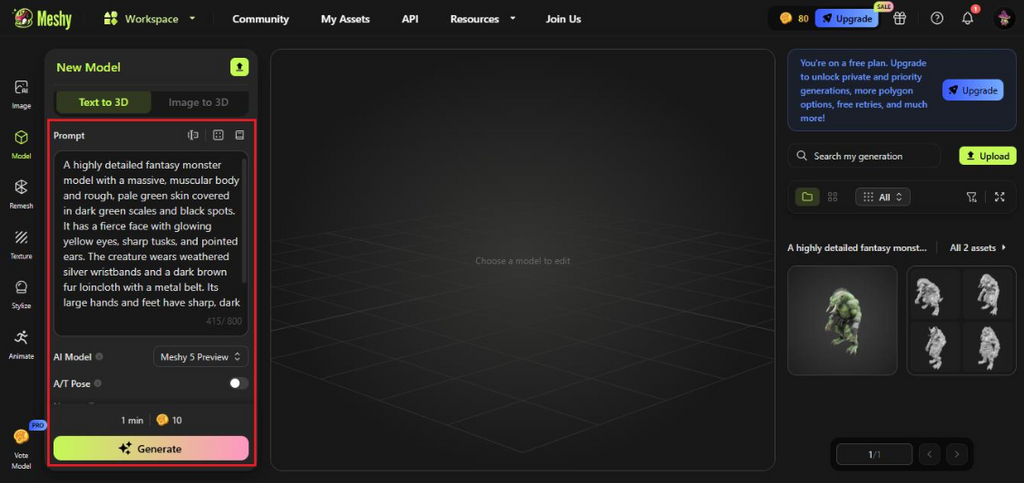
3D models created by artificial intelligence are rapidly evolving from a theoretical concept to a useful tool for designers. Users can avoid the tedious process of individually modeling each component by simply describing the object using text, uploading an image, or beginning with a sketch. The technology is also improving for 3D printing as AI systems are shifting their focus to exportable geometry instead of making aesthetically pleasing models.
Real-world example: Meshy
With its text-to-3D and image-to-3D generating capabilities, Meshy has advanced this trend. Meshy 7.1, released in September 2026, added Ultra 4K geometry detail, and its 3D Agent could transform any type of text, picture, or drawing into a 3D model. The business boasts that physical 3D printing is becoming an increasingly viable option for using its models.
You just need to explain what you need; the system will make a basic model, you can tweak it, and then send it to a slicer. It's starting to sound more like a discussion.
2. AI Is Moving From Model Creation to Print Monitoring
AI is not only helping create models. It is also being used to watch the printing process and identify failures before an entire print is wasted.
Cameras and sensors can monitor extrusion, layer formation, spaghetti failures, nozzle problems, and other abnormalities. Industrial systems are taking this further by analyzing layer-by-layer production data.
Real-world example: Bambu Lab H2D

Bambu Lab's H2D combines cameras, sensors, and AI-assisted monitoring. Its intelligent nozzle camera can detect issues such as material buildup, extrusion problems, nozzle clumping, and "air printing." The printer also monitors material flow from the AMS system toward the nozzle.
At the industrial level, Materialise uses AI-powered Layer Analysis in its Quality & Process Control software to identify defects and anomalies in metal additive manufacturing.
The direction is clear: printers are becoming systems that can observe and react, rather than simply follow a G-code file.
3. Multi-Color and Multi-Material Printing Is Getting Faster
Multi-color printing has traditionally involved compromises. Systems using multiple filaments often need purging, prime towers, or lengthy material changes.
New printer architectures are attacking this problem by changing how multiple materials reach the nozzle.
Real-world example: Creality SPARKX i8
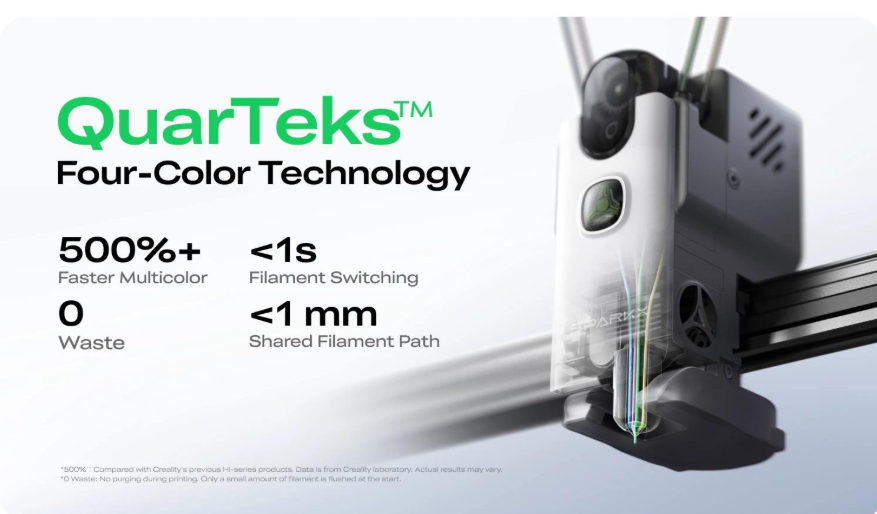
Creality debuted the SPARKX i8, a product of its color-changing QuarTeks architecture, in September 2026. Using four separate filament channels inside a single toolhead, the technology foregoes the traditional multi-toolhead method. According to Creality, this allows for four-color printing without the need for a prime tower or external purge waste.
Different systems are taking different approaches to the identical problem. For instance, the H2D from Bambu Lab features a dual-nozzle design that can handle a variety of materials.
This has led to a general trend toward 3D printers that are capable of printing increasingly intricate components all at once.
4. High-Speed 3D Printing Is Moving Toward Production
Speed remains one of the biggest limitations of additive manufacturing. In 2026, however, manufacturers are increasingly improving throughput through faster motion systems, higher material flow, multiple lasers, larger build areas, and better process control.
The goal is not simply to make a printer move faster. It is to produce more usable parts per production cycle.
Real-world example: HP Multi Jet Fusion 1200
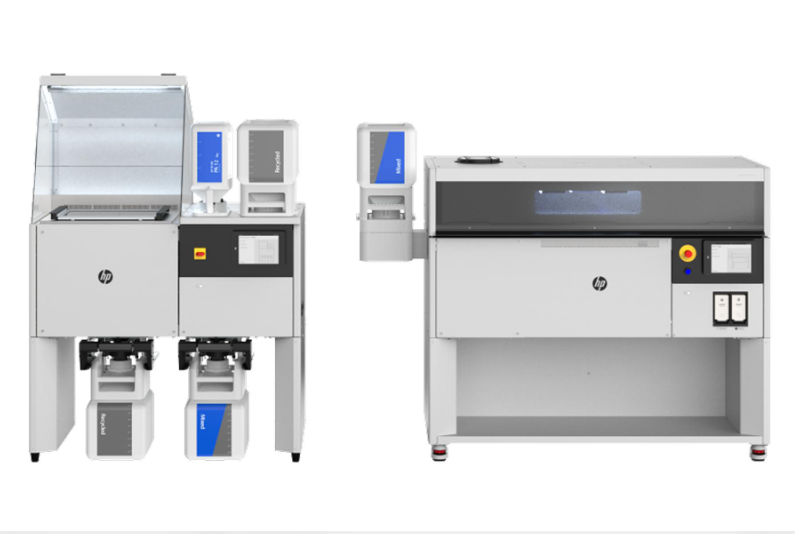
With the goal of bringing industrial MJF technology into production settings, HP unveiled the HP Multi Jet Fusion 1200 3D Printer Solution in 2026. Along with the expansion of its additive manufacturing portfolio to include metals and polymers for industrial use, HP revealed efficiency enhancements for its Jet Fusion 5600 series.
In a similar vein, 3D Systems debuted the SLA 825 Dual in 2026, which combined increased build volume and speed with dual-laser output. This development is facilitating the transition of 3D printing from prototype to mass production.
5. Metal 3D Printing Is Becoming More Productive and More Intelligent
Metal additive manufacturing is advancing beyond simply printing complicated shapes. Researchers and manufacturers are working on better materials, faster processes, improved monitoring, and more controlled laser behavior.
This matters because metal printing is increasingly being considered for demanding aerospace, automotive, energy, and industrial components.
Real-world example: Additive Industries MetalFab 420K
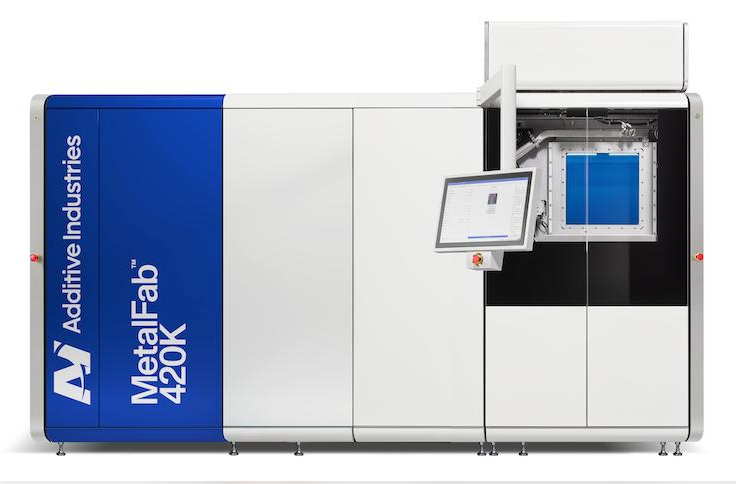
Additive Industries' MetalFab 420K uses four 1 kW lasers across a 420 × 420 × 400 mm build volume. Its design focuses on higher productivity while maintaining consistent material quality.
Research is also opening new possibilities. In 2026, NIST researchers demonstrated a laser-scanning approach that actively stirs molten metal during printing, potentially helping produce certain high-performance alloys.
The bigger trend is toward more controlled metal printing rather than simply faster metal printing.
6. Robotic Large-Format 3D Printing Is Creating New Manufacturing Models
Large-format additive manufacturing is expanding beyond giant prototypes. Robotic systems can now combine additive deposition with machining and other manufacturing operations.
This opens the door to producing large tooling, molds, structures, marine components, aerospace parts, and industrial fixtures closer to where they are needed.
Real-world example: Caracol's robotic microfactories
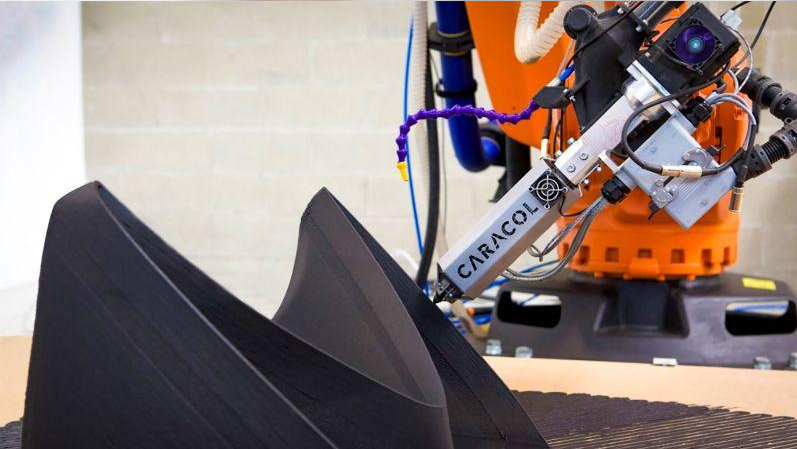
Caracol AM is developing a microfactory model that combines robotics, additive manufacturing, automation, and AI.
At IMTS 2026, Caracol demonstrated its HERON technology and showcased large components including satellite tanks, ship propellers, oil-and-gas components, and carbon-fiber motorsport tooling. Its customer, Freeman Boatworks, is using the HERON 300 HV hybrid system for large-scale tooling and composite parts.
Instead of sending every large component to a centralized factory, this model makes it possible to bring manufacturing capacity closer to the point of use.
7. Sustainable 3D Printing Materials Are Becoming More Creative
Sustainability in 3D printing is moving beyond simply recycling failed prints. Material manufacturers are experimenting with recycled polymers, bio-based materials, waste-derived fillers, and new composite formulations.
These materials can also create visual and functional properties that conventional filaments do not offer.
Real-world example: eSUN PLA-Coffee
By 2026, eSUN had introduced PLA-Coffee, a blend of PLA and processed used coffee grounds. To create the material, the business first dehydrated, ground, and modified coffee grounds before adding them to the filament.
Consider 3D-Fuel's ReFuel, a line of recycled filaments created from color-transition material and other in-house manufacturing scraps.
These innovations suggest that in the future, consumers may consider the origin of the material and the fate of production waste when making filament selections, in addition to strength, temperature resistance, and aesthetics.
8. 4D Printing and Bioprinting Are Expanding What "3D Printing" Means
Some of the most interesting developments are happening beyond conventional plastic and metal printing.
4D printing adds time-dependent behavior to printed structures. Certain materials can change shape or properties when exposed to heat, moisture, light, magnetic fields, or other stimuli. Current research is exploring applications in healthcare, aerospace, robotics, and adaptive structures.
At the same time, 3D bioprinting is progressing toward functional tissues and regenerative medicine.
Real-world example: ARPA-H PRINT program
In January 2026, ARPA-H announced awards through its PRINT program to develop technology for producing personalized, immune-matched human organs using bioprinting.
One funded team at Carnegie Mellon University is working on a 3D-bioprinted liver that could temporarily support patients with acute liver failure.
These technologies are still largely in research and development, but they demonstrate how additive manufacturing is moving toward objects that can adapt, function biologically, or change over time.
Final Verdict
In 2026, 3D printing is advancing in intelligence, speed, and automation. In the realm of manufacturing, advancements in AI are enhancing print and design monitoring, new hardware is facilitating high-speed printing and multi-material printing, and innovative materials are broadening the scope of made goods.
This bodes well for makers since it simplifies design, reduces faulty prints, and makes machines more adept overall. What this means for producers is that they can make complex parts faster, with better quality control, and in innovative ways. Moving beyond the simple printing of products into the construction of intelligent production systems is the future of 3D printing.