
Fabbrix Elemento TC: Large-Format 3D Printer With a Tool Changer
Large industrial parts often require a bigger build area, reliable motion control, and materials that can handle demanding applications. The Fabbrix ELEMENTO TC brings these capabilities together in an industrial FFF 3D printer designed for large components and production runs.
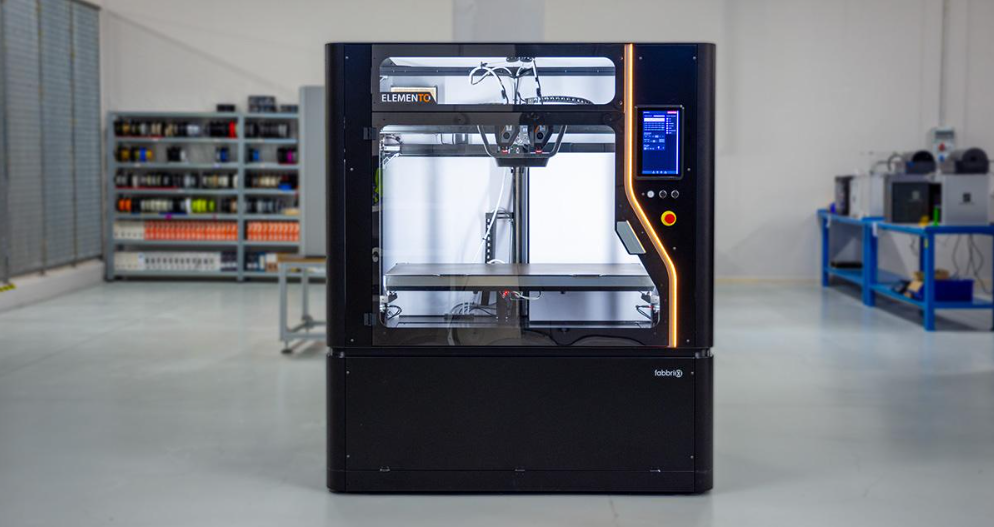
Its main features include an 1100 × 600 × 620 mm build volume, a tool-changing extrusion system, a triple-motor Z-axis, and a maximum nozzle temperature of 350°C. It also supports a wide range of engineering materials, giving manufacturers more flexibility when producing prototypes, fixtures, and functional parts.
1. Large 1100 × 600 × 620 mm Build Vol
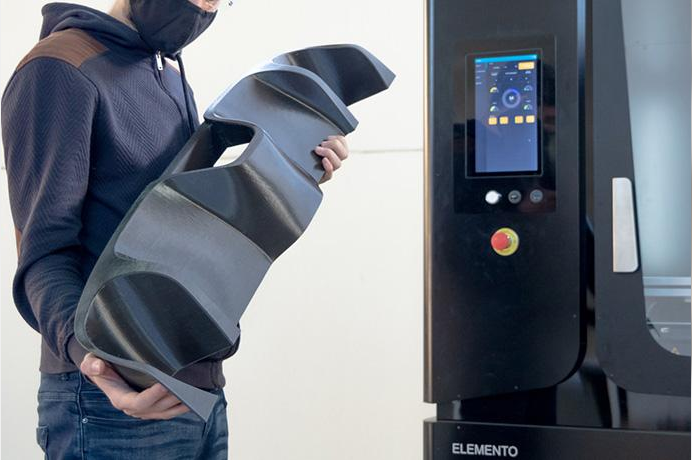
The ELEMENTO TC has a build volume of 1100 × 600 × 620 mm, making it suitable for printing large components that may not fit inside standard desktop printers.
This space can accommodate sizable prototypes, industrial housings, manufacturing fixtures, and multiple smaller components in one print job. Printing a part in fewer sections can also reduce the need for assembly, adhesives, and additional fasteners.
The printer measures approximately 1630 × 1170 × 1880 mm and weighs 580 kg. It is therefore designed for a dedicated industrial workspace rather than a typical home workshop.
2. Tool Changer for Flexible Printing
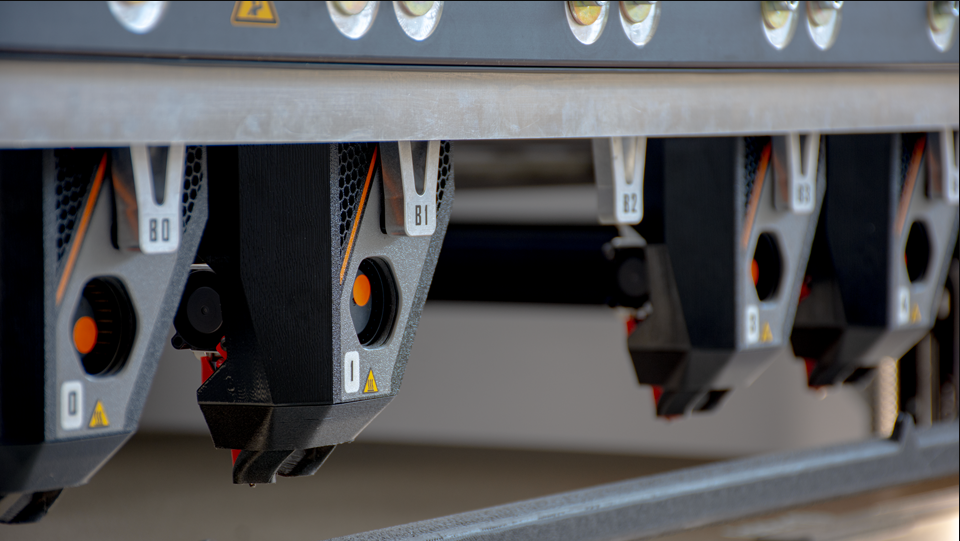
The ELEMENTO TC is known for its tool-changing mechanism. Instead of depending on a single fixed extrusion arrangement for every job, the printer may switch between different printheads.
Manufacturers can use this information to tailor printing jobs to specific nozzle sizes or extrusion needs. To print large parts rapidly, for instance, a bigger nozzle is ideal, while a smaller nozzle is better suited for tasks that call for finer details.
The nozzle diameters listed by Fabbrix are 0.6, 0.8, 1.0, and 1.2 mm. Configurations with one or two printing nozzles are detailed in the original ELEMENTO TC specification. Contrast this with the more recent ELEMENTO TC5, which features five separate toolheads.
3. High-Speed Linear Motion With Encoder Feedback
Fabbrix equips the ELEMENTO TC with high-speed linear technology and integrated encoders. These encoders monitor axis movement and help the machine maintain controlled, consistent motion.
This matters during long print jobs. Even small motion inconsistencies can affect dimensional accuracy, layer alignment, and surface quality, particularly when printing large components.
The printer has a listed maximum build speed of 300 mm/s. However, this is a maximum specification rather than a guarantee that every material and model can print at that speed. Actual results depend on the nozzle, material, layer height, extrusion flow, and geometry.
4. Triple Independent Z-Axis Motors and Automatic Bed Leveling
Due to the significantly larger build surface area, bed alignment becomes more important in large-format printing. Three separately powered Z-axis motors in the ELEMENTO TC take care of this.
A scanning probe measures the build surface and adjusts for bed tilt as part of its automatic leveling system. Because of this, the printer is able to create a first layer that is more uniform across the vast platform.
A PEI coating allows the PEI-coated, flexible magnetic build plate to withstand temperatures of up to 120~°C. You can improve first-layer adhesion and decrease the danger of parts lifting during long prints by using a properly leveled and heated platform.
Large components benefit greatly from these characteristics because a first-layer failure can result in significant material and machine time waste.
5. High-Temperature Printing up to 350°C
The ELEMENTO TC has a maximum nozzle temperature of 350°C, allowing it to process a broad range of filament types when the correct print profile and hardware configuration are used.
Its open-material system supports Fabbrix filaments and compatible third-party materials. The manufacturer's listed material families include:
- Standard and modified plastics: PLA, PLA-R, PLAHT, PETG and PETG-R.
- Engineering materials: ABS, ASA, nylon, PC and PC/ABS.
- Reinforced materials: PETCF, PACF, PAGF, PPCF, PPGF and PPSCF.
- Specialty materials: TPU, CNT, and BVOH.
Not every filament will use the same temperature or printing setup. Reinforced polymers, flexible materials, and high-temperature plastics may require specific drying, extrusion, adhesion, and ventilation practices. Check material compatibility and the recommended profiles before starting a production job.
6. Multiple Nozzle Sizes for Speed or Detail
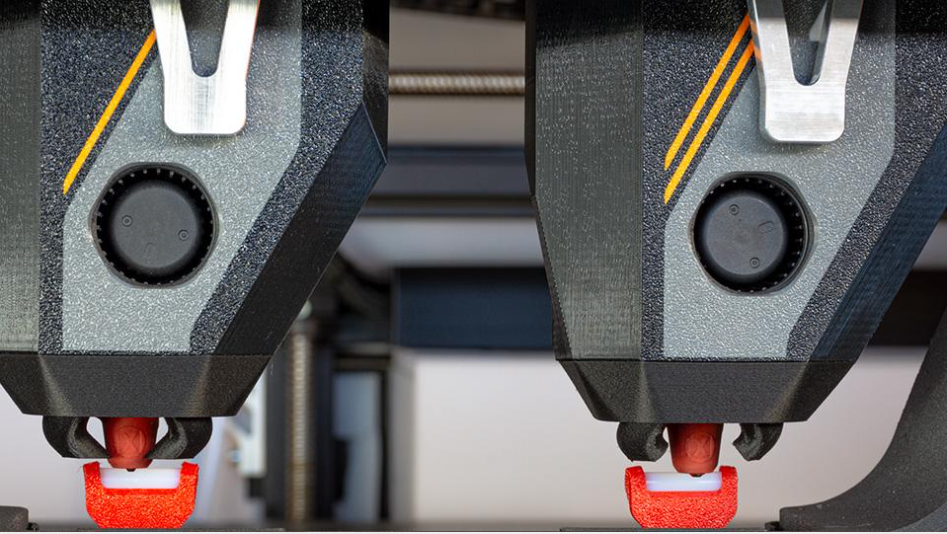
The ELEMENTO TC supports nozzle diameters from 0.6 to 1.2 mm, giving operators several options for balancing print speed and feature detail.
A 1.0 or 1.2 mm nozzle can deposit wider lines, making it useful for large parts where production time matters more than very fine surface detail. A 0.6 mm nozzle can provide a better balance when the model includes smaller features.
The listed layer-resolution range is 0.15–0.9 mm, although the usable layer height depends on the nozzle and selected print profile.
Larger nozzles can reduce the number of passes needed to build thick walls, but they do not automatically guarantee stronger parts. Material choice, layer bonding, wall design, and print orientation remain important.
7. Wi-Fi, LAN, USB, and an 11.6-Inch Touchscreen
The ELEMENTO TC includes Wi-Fi, LAN, and USB connectivity for handling print files and connecting the machine to a production workflow. It uses Ultimaker Cura as its listed slicing software and accepts common 3D formats, including STL, OBJ, X3D, and 3MF.
An 11.6-inch touchscreen provides the main interface for operating the printer. The machine also includes a webcam, which can help operators observe print progress.
These features are useful when a large print run lasts for many hours. Operators can prepare files, manage jobs, and monitor progress without treating the printer as a basic standalone machine.
8. HEPA and Activated Carbon Filtration
In order to filter out nanoparticles and volatile organic compounds (VOCs), the ELEMENTO TC has a filtration system that is HEPA plus activated carbon.
Because emissions differ depending on the material and printing conditions, this is a crucial factor to consider when dealing with engineering plastics. Proper ventilation, proper material handling, and other workplace risk controls are still necessary in addition to filtration, which can assist in reducing airborne contaminants.
Makers need to pay attention to both the printer's instructions and the filament's safety recommendations.
Fabbrix ELEMENTO TC Specifications at a Glance
|
|
|
|
|
|
|
|
|
|
|
|
|
|
|
|
|
|
|
|
|
|
|
|
|
|
|
|
|
|
|
|
|
|
|
|
|
|
|
|
|
|
|
|
|
|
|
|
|
|
|
|
|
|
|
|
|
What Can You Make With the ELEMENTO TC?
While the ELEMENTO TC can handle small-scale ornamental prints, it is more suited for large-scale additive manufacturing. Thanks to its spacious build area and ability to accommodate engineering materials, it is ideal for producing functional housings, bespoke fixtures, large prototypes, and certain components for final use.
Printing several components at once or making big parts directly might be useful for manufacturers in the engineering, packaging, automotive, and product design industries. Compared to printing on a machine that can only utilize one proprietary filament range, the open-material approach offers consumers more options.
But not all designs are good candidates for one-piece printing, even with a high build volume. It is important to think about the part's size, the possibility of warping, mechanical stresses, material qualities, and production costs before deciding on a manufacturing method.
Design Large-Format Parts With SelfCAD
Before sending a model to the ELEMENTO TC, you need a design that fits the build area and suits the chosen material. SelfCAD is a useful 3D design tool for preparing custom parts, prototypes, and fixtures. Its Boolean tools let you create cutouts and join shapes, while Fillet and Chamfer help refine edges. Simplify Object can reduce unnecessary mesh complexity, and Magic Fix can repair common mesh problems before slicing. After checking the model's dimensions and geometry, you can export it in a suitable format for your printer workflow.
Final Verdict
With its huge build volume, encoder-monitored motion, triple-motor Z-axis, and tool-changing extrusion system, the Fabbrix ELEMENTO TC is an industrial large-format FFF printer. Its open-material approach and maximum nozzle temperature of 350°C make it suitable for a wider range of engineering prototypes and production components.
The capacity to print big components, choose from many nozzle diameters, and use a wide variety of compatible materials are its key strengths. It is best suited to companies with adequate facilities and production needs because of its 580 kg weight, significant footprint, and industrial operation requirements.