
Creality CR-Scan vs Revopoint: Key Differences and Which One Is Better?
Choosing a 3D scanner is not only about looking at the accuracy number on the box. The scanning technology, tracking, object size, software, portability, and surface handling can all change the experience.
Creality CR-Scan and Revopoint both offer scanners for beginners, makers, designers, and professional users. But their product ranges are quite different. So, which brand is better? The answer depends heavily on what you want to scan.
Creality CR-Scan vs Revopoint: Quick Comparison
|
|
|
|
|
|
|
|
|
|
|
|
|
|
|
|
|
|
|
|
|
|
|
|
|
|
|
|
|
|
|
|
|
|
|
|
|
|
|
|
|
|
|
|
|
|
|
|
1. Scanning Technology
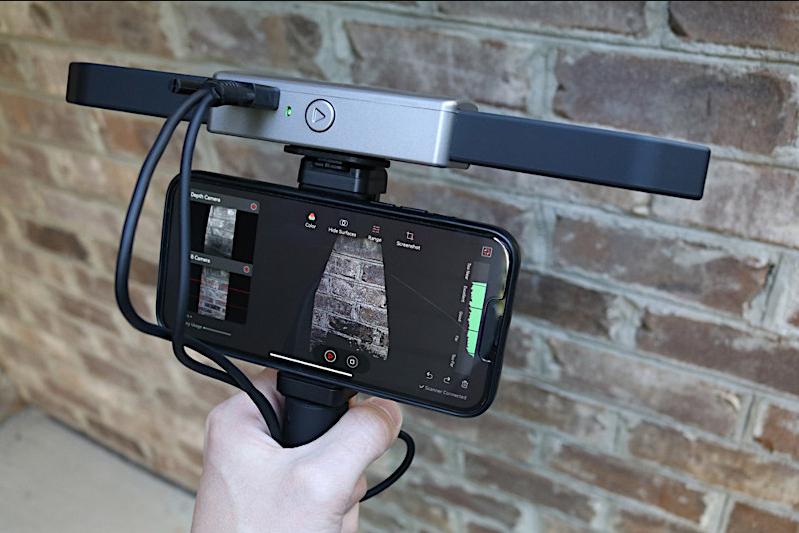
Creality CR-Scan: There is a significant distinction in this regard. Utilizing structured-light technology, numerous reasonably priced CR-Scan variants are available. For instance, the Ferret SE provides infrared scanning capabilities, including 24-bit full-color scanning and an accuracy level of up to 0.1 mm.
The next-generation CR-Scan Raptor uses blue laser scanning technology. The latest Raptor model provides precision to within 0.02 mm by means of seven blue parallel laser lines. Creality also has Raptor variants that use a combination of infrared and hybrid laser technology.
Revopoint: Revopoint has a comparable approach, although their technology portfolio is far more extensive. The MetroX series integrates full-field blue structured light with multi-line blue laser scanning. While MetroX Pro provides volumetric accuracy of up to 0.02 mm + 0.04 mm × L, MetroX can achieve single-frame precision of up to 0.01 mm.
Winner: Revopoint for technology range.
2. Accuracy and Detail
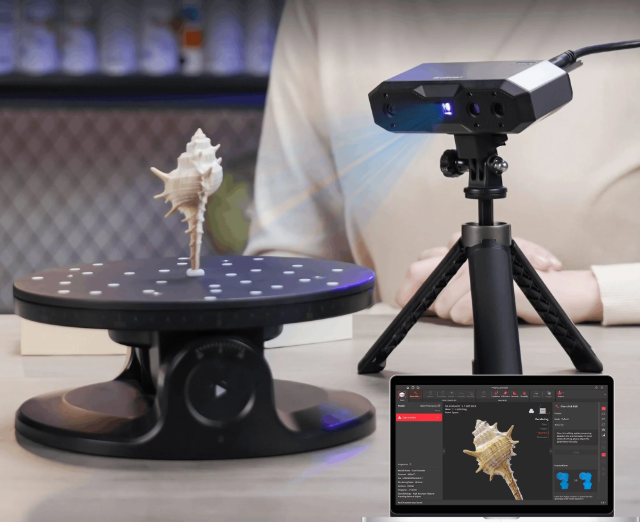
Creality CR-Scan: The accuracy is scanner-dependent. According to the model and scanning mode, the CR-Scan Raptor may achieve an accuracy of 0.02 mm, and the Raptor line as a whole offers 3D resolution ranging from 0.02-2 mm.
Revopoint: Revopoint's premium scanners are capable of much greater feats. While additional models aim for varying levels of accuracy and object sizes, the current comparison lists the MetroX and MetroY models with 0.01 mm single-frame precision.
For objects ranging from tiny to medium in size, Revopoint's MetroX has four distinct scanning modes. Its maximum frame rate employing full-field structured light is 7 million points/second. One should not assume that a better scan will result from a higher specification. Additional factors to consider are tracking, calibration, surface area, distance, and scanning method.
Winner: Revopoint for maximum precision.
3. Scanning Difficult Surfaces
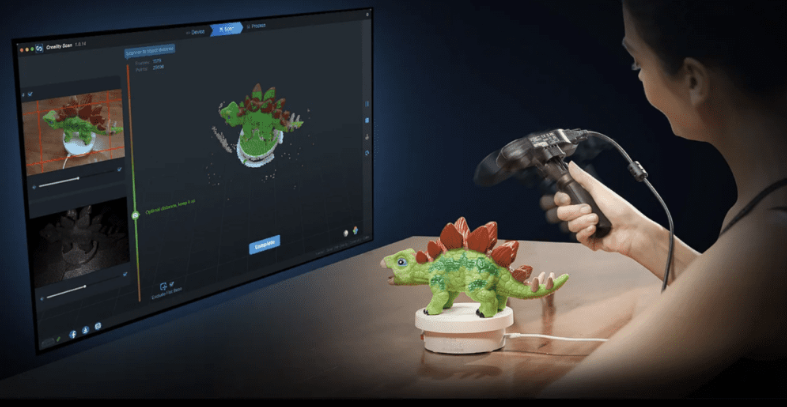
Creality CR-Scan: Black and reflective objects can be difficult for traditional structured-light scanners. This is where blue laser scanners become useful. Creality's Raptor can scan black and highly reflective surfaces using its laser technology. This can reduce the need for scanning spray on suitable objects.
Revopoint: Revopoint's MetroX series also focuses heavily on difficult surfaces. Revopoint says the MetroX can scan shiny and black surfaces without scanning spray when using its multi-line laser mode.
This makes the laser-based models much more interesting for automotive parts, metal components, tools, and industrial objects. The higher-end laser models from both companies are much better choices for difficult surfaces than their basic structured-light scanners.
Winner: Tie.
4. Object Size
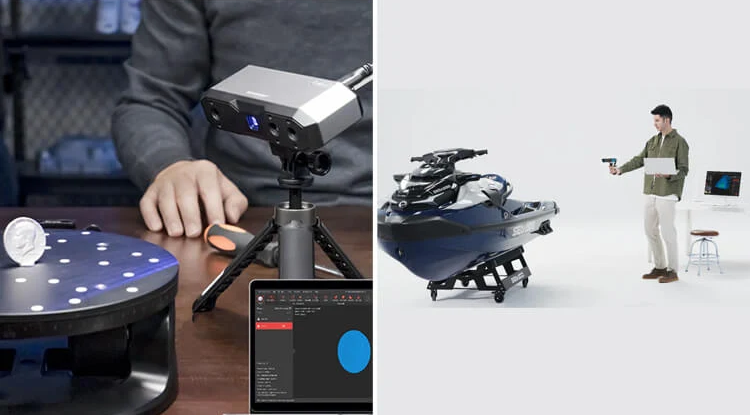
Creality CR-Scan: The object's size is a major factor in determining the best scanner to use. The CR-Scan line from Creality can scan anything from tiny components to big things. Examples of things provided for the Raptor range from approximately 5 mm to 2,000 mm, depending on the model.
Revopoint: Revopoint offers a wide range of options for various sizes. The MetroX focus is on small to medium items, whilst the RANGE 2 is capable of handling objects up to 4 × 4 × 4 meters in size. Objects ranging in size from micrometers to almost four meters are all within the MIRACO series' capabilities. For tasks requiring scanning of both small components and huge items, Revopoint is the way to go. Its specialized scanner families make it easy to select a specific object size.
Winner: Revopoint.
5. Software and Workflow
Creality CR-Scan: Both companies provide dedicated scanning software. Creality uses CrealityScan. It supports scanning, processing, editing, alignment, and exporting. It can also produce common formats such as STL, OBJ, PLY, and 3MF.
Revopoint: Revopoint uses Revo Scan for its scanner ecosystem. The software handles scanning, alignment, editing, merging, and other processing tasks. Revopoint also supports common 3D formats used for design and printing.
For a 3D-printing workflow, both are practical because scanned models can be processed and exported for use in CAD or slicer software.
Winner: Tie.
The better choice here may simply be the software you find easier to use.
6. Portability and Standalone Scanning
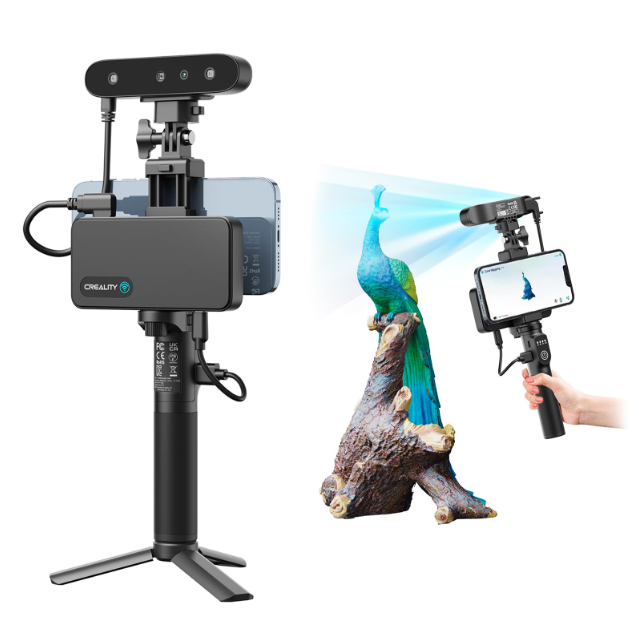
Creality CR-Scan: This is another area where the models differ greatly. Some CR-Scan models are designed to be lightweight and portable. The CR-Scan Ferret, for example, weighs only 105 grams, making it easy to carry around.
Revopoint: Revopoint's MIRACO takes a different approach. It is an all-in-one scanner that can capture and process scans without requiring a separate computer. Revopoint describes it as a standalone scanner for objects ranging from small parts to large objects.
This can be useful when scanning vehicles, furniture, sculptures, or objects in locations where carrying a computer is inconvenient.
Winner: Revopoint for standalone professional workflow.
Creality wins for ultra-light basic scanning.
7. Which Is Better for 3D Printing?
When it comes to 3D printing, both brands are reliable. To create a digital replica of an existing physical component, all you need is a scanner. After that, you can make any necessary repairs and edits, and send the mesh to a slicer.
If you're just starting or are a hobbyist, you may get away with an inexpensive CR-Scan or Revopoint scanner for simple reverse engineering, scanning household items, and replacing parts.
A more appropriate laser scanner, like the Revopoint MetroX or Raptor, would be appropriate for more intricate mechanical components. Their improved precision and ease of use on rough surfaces allow them to generate more reliable data for precise tasks. Skip the brand-specific selections. Scan models that are compatible with the scanner.
Winner: Tie, depending on the scanner.
8. Which Brand Is Better for Beginners?
Creality CR-Scan: Creality has a strong advantage if you want a relatively simple entry point. The CR-Scan Ferret SE is positioned as an affordable scanner and offers features such as anti-shake tracking and full-color scanning.
Revopoint: Revopoint also has beginner-friendly options. Its INSPIRE family is designed for hobbyists, creative work, and 3D printing. The newer INSPIRE 2 adds infrared multi-line laser scanning and reaches up to 0.05 mm single-frame accuracy.
Winner: Creality for budget-focused beginners.
Revopoint wins if you want more room to upgrade within the same brand.
9. Price and Value
Price varies considerably between models and promotions. Creality currently lists the CR-Scan Raptor at $879 on its US store, compared with a listed regular price of $1,499.
At the other end, the CR-Scan Ferret SE is listed at $319, while the Ferret is listed at $349 on Creality's official site. Revopoint's current comparison lists the POP 4 at $839, while higher-end models such as MetroY Ultra and MetroY Pro are listed at $1,899 and $1,495, respectively.
Winner: Creality for entry-level and laser value.
Revopoint can justify its higher prices on models that add more advanced scanning technologies and workflows.
Which One Should You Buy?
Creality CR-Scan: Choose Creality CR-Scan if you want a good balance of price, portability, and scanning capability. It is especially attractive if you already use Creality's 3D-printing ecosystem.
Choose Revopoint if you want a wider selection of scanners and expect your scanning needs to grow. Its lineup covers everything from beginner scanning to advanced laser and standalone systems.
For specific needs:
- Budget scanning: Creality CR-Scan Ferret SE
- Portable beginner scanning: Creality Ferret or Revopoint INSPIRE 2
- Detailed laser scanning: Creality Raptor or Revopoint MetroX
- Large objects: Revopoint RANGE 2 or MIRACO
- Standalone workflow: Revopoint MIRACO
- Professional tracking: Revopoint Trackit
- 3D-printing and general hobby work: Either brand, depending on the scanner
Best 3D Modeling Software
SelfCAD is a strong 3D design tool to use alongside scanners such as Creality CR-Scan and Revopoint. After importing a scanned model, you can use Magic Fix to repair common mesh issues, Simplify to reduce unnecessary geometry, Fillet to smooth sharp edges, and Chamfer to create clean, printable edges. These tools make SelfCAD useful for cleaning, modifying, and preparing scanned models before sending them to a slicer for 3D printing.
Final Verdict: Creality CR-Scan vs Revopoint
There is no single winner across every price range. Creality CR-Scan is the better value choice if you want an affordable scanner or a high-end laser scanner without moving into the most expensive professional systems.
Revopoint is the better overall ecosystem if you want more choices as your scanning needs become more advanced. Its lineup now covers beginner, portable, large-object, laser, metrology, and standalone scanning applications.
For most 3D-printing users, we would choose Creality for value and Revopoint for versatility. The important part is to compare the actual scanner model, not just the brand name.