
Bambu Lab AI Failure Detection: How It Works
A failed 3D print can waste hours of machine time and a significant amount of filament before you notice what went wrong. Bambu Lab addresses this problem with AI-powered failure detection and automated print monitoring.
The technology combines cameras, computer vision, printer sensors, and software to identify certain failure patterns while a print is running. Depending on the printer, it can detect problems such as spaghetti, nozzle blobs, air printing, and extrusion abnormalities. Here's how Bambu Lab's AI failure detection works and what it can—and cannot—detect.
What Is Bambu Lab AI Failure Detection?
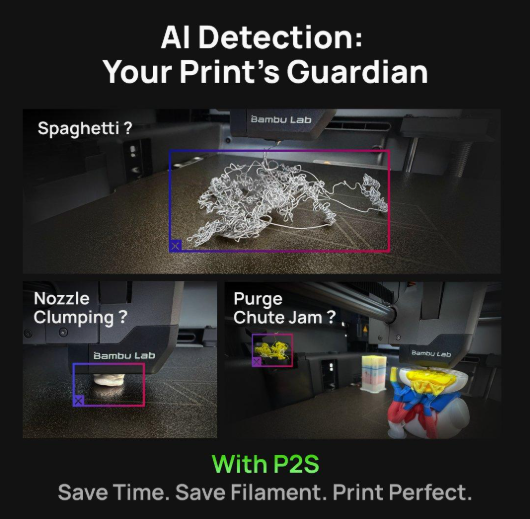
Some printers include Bambu Lab's AI failure detection, essentially a machine vision and sensor-monitoring system. Various sensors can track things like filament movement and extrusion behavior, while cameras keep an eye on the print area or nozzle. Afterward, the software examines this data for trends linked to previously identified printing errors.
For instance, the X1C includes capabilities like AI-inspected first-layer identification and spaghetti failure detection, according to Bambu Lab. In addition, the X1C employs LiDAR for targeted calibration and inspection tasks.
More recent models broaden the idea. In addition to checking the build plate and nozzle setup, Bambu Lab claims that the P2S utilizes AI-powered computer vision to detect spaghetti, nozzle blobs, and air printing.
Keep in mind that just because a printer has AI failure detection capabilities does not imply it comprehends every detail of a 3D build. You can train it to spot certain patterns in visual or sensor data that could be an indication of an issue.
How Does the Detection System Work?
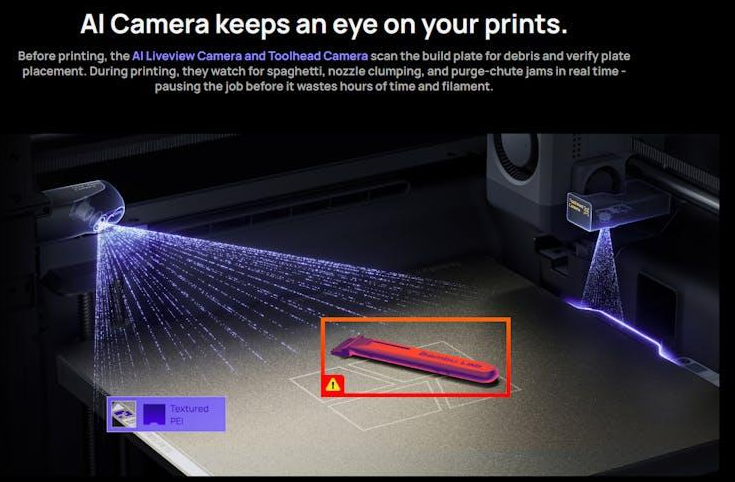
The basic process can be simplified into four steps:
Camera or sensor → data analysis → failure recognition → alert or printer response
The printer records data regarding the printing process. While sensors can track the extrusion process or the flow of filament, a camera can take pictures of the work area or the nozzle.
Afterward, the program checks these details against patterns linked to previously identified failure scenarios. The system can alert the user and, depending on the printer and circumstances, halt the print job when it finds a strong enough match.
1. The Camera Monitors the Print
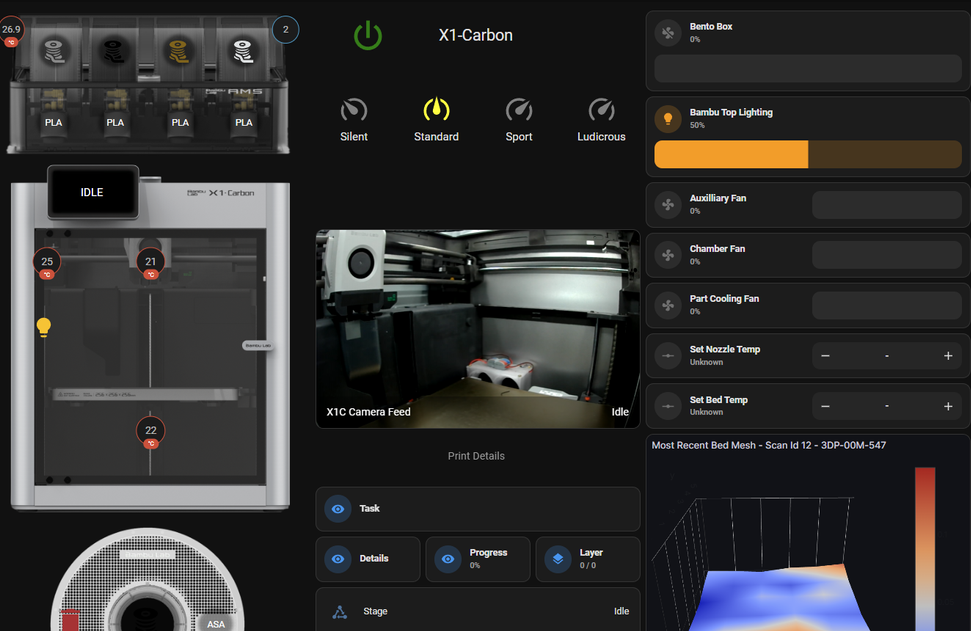
An essential part of Bambu Lab's AI surveillance system is the camera. The X1C's camera-based monitoring system can identify spaghetti. While printing, the system keeps an eye on the print area for any noticeable deviations from the planned pattern.
When a failure causes noticeable alterations to the appearance, this is a lifesaver. One such example is a detachable model. As the printer continues to execute the G-code, the nozzle has the potential to deposit filament into space if the part comes off the build plate. At some point, the untangled filament can resemble a tangled mess rather than a successful print.
The AI can detect a potential failure based on this visual difference. But what a camera can't see well, it can't detect. Failure type, lighting, impediments, and camera position can all affect detection.
2. AI Looks for Specific Failure Patterns
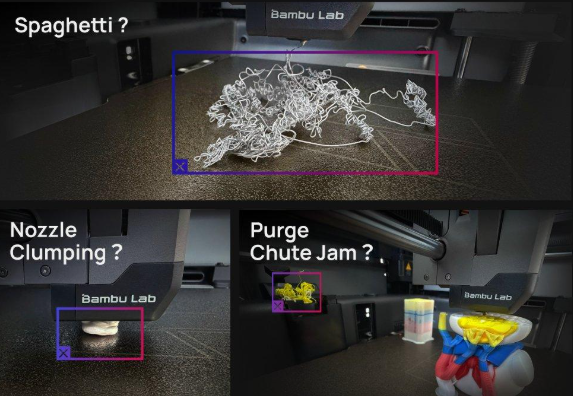
Bambu Lab's AI system is not simply asking whether a print "looks bad." Instead, it looks for recognizable patterns associated with particular failure conditions.
The P2S is a good example. Bambu Lab specifically identifies spaghetti, nozzle blobs, and air printing as conditions its AI-powered computer vision can detect. This distinction matters because there are many ways a 3D print can fail. AI monitoring may recognize a large spaghetti failure while not necessarily identifying:
- Slight dimensional inaccuracies
- Weak layer adhesion
- Minor surface defects
- Incorrect temperature
- Small amounts of stringing
- Some forms of under-extrusion
These problems can still ruin a print, but they may not create a visual pattern that the detection system is designed to recognize.
3. Newer Printers Monitor the Nozzle More Closely
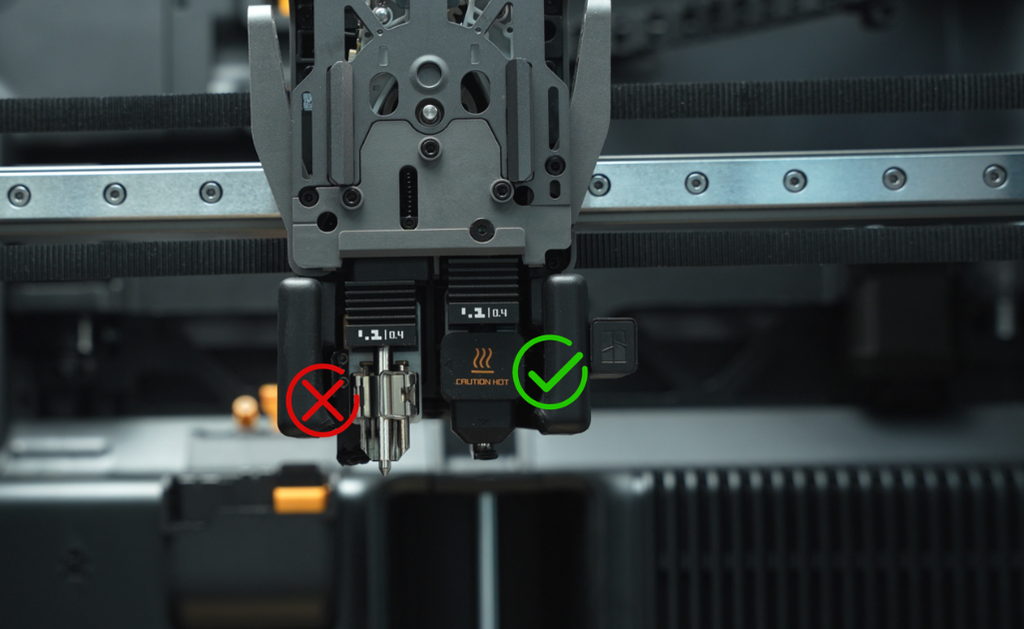
With its Intelligent Nozzle Camera, the more recent H2D from Bambu Lab expands upon the idea. This camera allows you to see the area around the nozzle and the extrusion process in great detail, rather than just getting a bird's-eye view of the construction area.
According to Bambu Lab, the H2D's platform can identify issues including spaghetti, air printing, nozzle clumping, filament variations, and material accumulation. Not all issues manifest themselves throughout the print; in some cases, they begin at the nozzle, making close-up monitoring all the more valuable.
An expanding mass of plastic surrounding the nozzle, for instance, poses the risk of crushing the printed model upon impact. If the printer can identify the unusual accumulation of materials sooner, it will have a higher chance of informing the user.
4. Bambu Lab Combines AI With Extrusion Sensors
Camera monitoring is only one part of Bambu Lab's newer approach. The H2D also uses extrusion-related sensing. Its DynaSense Servo PMSM Extruder monitors extrusion pressure and can detect conditions such as partial nozzle clogs and filament grinding.
Bambu Lab describes its filament monitoring system as tracking parameters such as feeding velocity, filament tension, filament position, the extruder's thermal environment, and dynamic extrusion pressure. This creates a more comprehensive monitoring system.
A camera can tell the printer what the print looks like, while extrusion sensors can provide information about what is happening inside the filament path.
5. First-Layer Inspection Is a Separate Feature
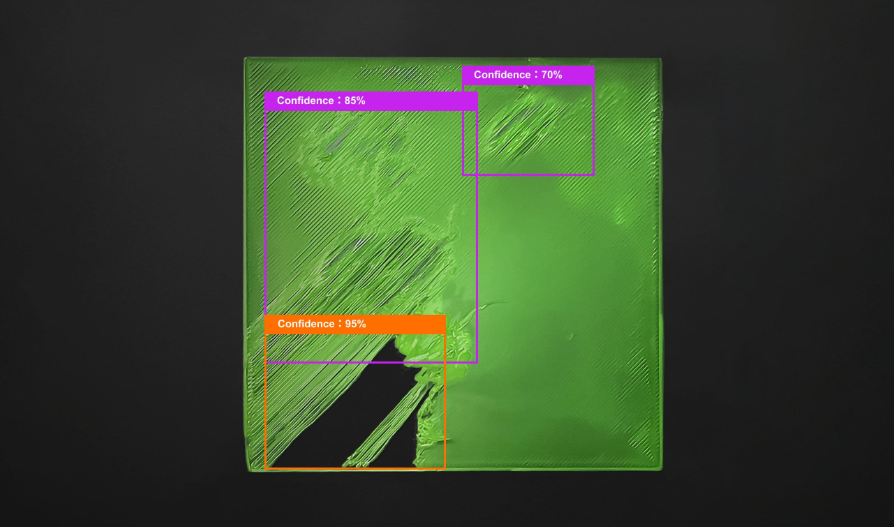
Bambu Lab's first-layer inspection should not be confused with continuous spaghetti detection.
The X1C uses its LiDAR system for first-layer inspection. Bambu Lab describes the feature as an automated way of checking the first layer rather than requiring the user to manually monitor it. This provides an early opportunity to identify problems.
Therefore, first-layer inspection and failure detection serve different purposes:
First-layer inspection: attempts to identify problems early.
Failure detection: identifies certain failure patterns while printing.
Extrusion monitoring: checks what is happening in the material-delivery system.
Together, these systems provide broader protection than any single sensor could provide.
What Happens When AI Detects a Failure?
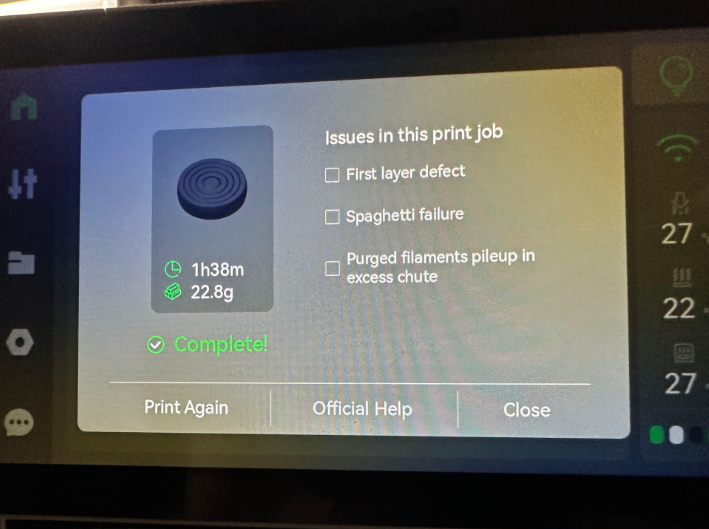
For detection to be effective, the printer must be able to react properly. When Bambu Lab systems identify a fault, they can either warn the user or pause the print job, depending on the printer, firmware, failure type, and settings. Before continuing, the user should always check the physical print.
For instance, in the event that the printer indicates the presence of spaghetti, it is important to verify if the model has come loose, if filament has collected around the nozzle, and if the build plate is still appropriate for proceeding.
Expert tip: Never treat an AI warning as something to dismiss automatically. A false positive may waste a few seconds of inspection, but blindly continuing a genuinely failed print can create a much larger cleanup problem.
8. How to Get Better Results From AI Monitoring
There are a few simple things you can do to make automated monitoring more useful.
- Keep the printer's cameras clean and unobstructed. A dirty lens can make it harder for computer-vision systems to interpret what is happening.
- Keep the printer's firmware and related software updated so you have access to the latest supported detection improvements.
- You should also establish a reliable printing profile before depending on automated monitoring.
- Correct bed preparation, appropriate filament settings, proper nozzle temperature, and calibrated extrusion remain important.
Expert tip: Run the first layer yourself when starting a new filament, build plate, or unfamiliar model. Once the first layer is confirmed, AI monitoring becomes an additional safeguard rather than your first line of defense.
Which Bambu Lab Printers Use AI Failure Detection?
Bambu Lab's capabilities vary between models.
The X1C combines camera-based spaghetti detection with AI first-layer inspection and LiDAR-based functions.
The P2S expands AI computer vision to conditions such as spaghetti, nozzle blobs, and air printing, along with additional pre-print checks.
The H2D adds an Intelligent Nozzle Camera and more extensive extrusion monitoring, including detection of extrusion abnormalities and partial nozzle clogs.
The H2C continues the multi-camera and multi-sensor approach, using nozzle and toolhead monitoring alongside filament and other sensors.
Therefore, it is better to compare the specific detection features of each printer rather than assuming that every Bambu Lab machine has the same AI capabilities.
SelfCAD: Best AI 3D Modeling Software
While Bambu Lab's AI failure detection focuses on identifying potential printing problems, SelfCAD takes AI into another area of 3D printing: model creation. If you want to use AI to generate 3D models from text prompts or reference images, SelfCAD is one of the best AI-powered 3D modeling solutions to consider. Its AI tools allow users to turn written descriptions and images into 3D models without having to create everything manually. Beyond generation, SelfCAD provides a complete 3D modeling environment with tools such as Boolean Operations, 3D Sculpting, Deform Tools, Shape Generators, and Magic Fix for repairing mesh issues. Users can also edit their generated models, refine their geometry, and prepare them for printing using the integrated SelfCAD Slicer. This makes SelfCAD particularly useful for designers, hobbyists, and 3D printing enthusiasts who want to move from an idea to a printable 3D model using AI and traditional modeling tools in one platform.
Conclusion
AI monitoring is useful, but it is not a guarantee against failed prints. The system depends on the camera's view, available sensor data, and whether the problem matches a failure pattern that the software can recognize.
For example, a small extrusion inconsistency might not produce a sufficiently obvious visual change. A filament-feed problem may also occur without immediately creating the type of spaghetti pattern the camera is looking for.
Bambu Lab users have reported both missed failures and false positives in community discussions. These reports should be treated as user experiences rather than official measurements of detection accuracy.
This is why AI monitoring should be considered an additional safety layer rather than a replacement for proper printer setup and supervision.